01
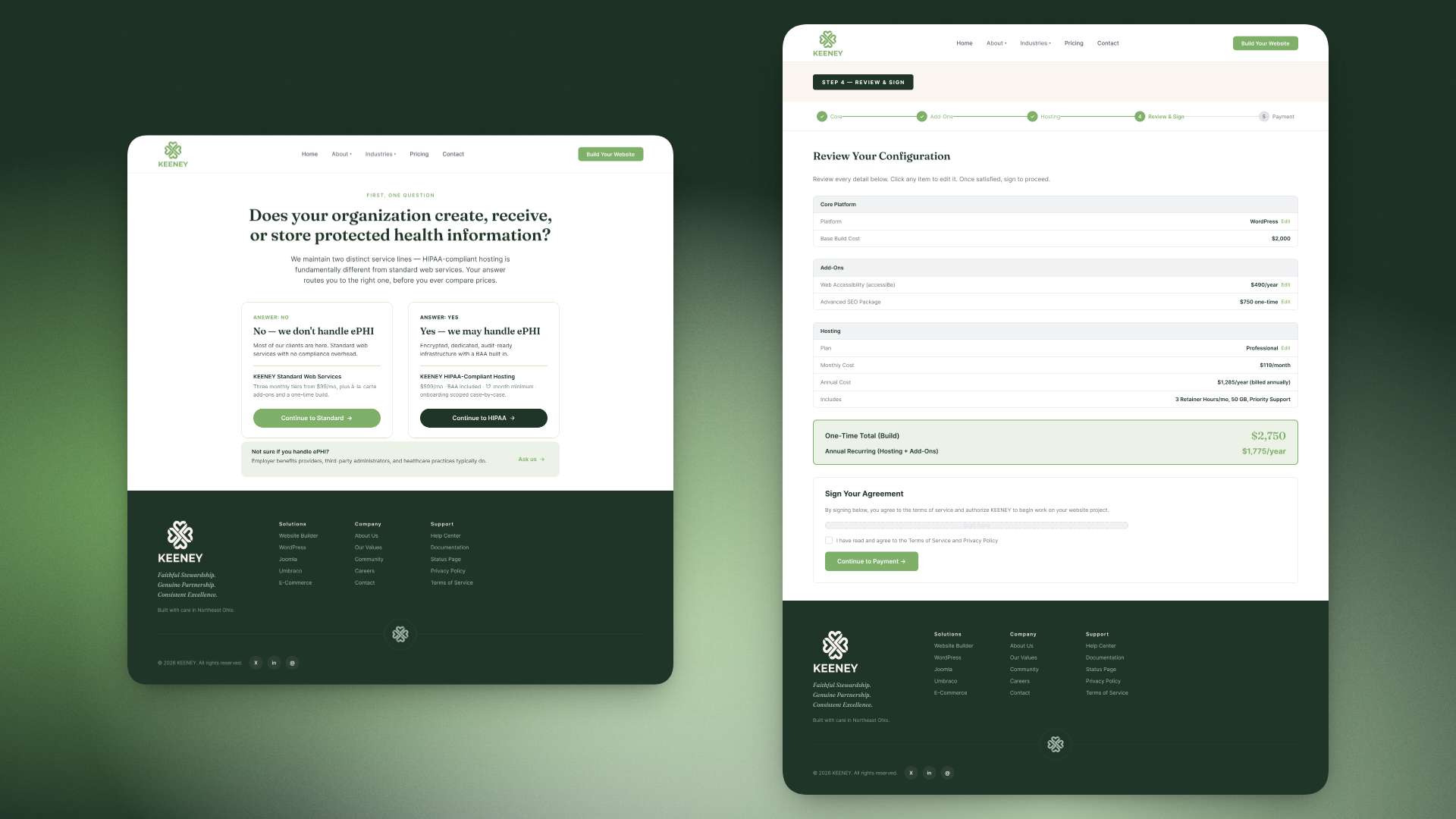
Keeney — Website Configurator
The self-serve heart of Keeney’s promise: a five-step configurator that lets a small business build and buy a custom website — live pricing throughout, financing at checkout, and no sales call anywhere in the flow.
Senior UX/UI Designer + Frontend Developer
Eight years designing interfaces, and a developer's hands to build them. They used to call this a unicorn, then a full-stack designer — design engineer is the better name. In practice it means one person from research and IA, through UI and a design system, into production code.
How I work
The same three rules, on every project, for eight years. A product is never truly finished — great design is a loop, not a finish line.
Start with the problem, not the interface. Stakeholder interviews, user research, and an audit of where the current experience breaks down — ranked by how often it hurts and how much. Before anything is drawn, there is a written definition of better, in numbers.
Not a compliance pass bolted on at the end. Contrast, focus order, and keyboard operation are design constraints from the first wireframe, the same way responsive behaviour is — which is why the QA pass is short.
I started as a web developer and never put the editor down. Component architecture, responsive implementation, and the accessibility work that only exists in markup — built in Framer, in Webflow, or in the codebase alongside the engineering team. What ships is what was designed, pixel for pixel.
Selected work
The proof
Process
The same spine on every project — scaled up or down to fit, never skipped.
Start with the problem, not the interface. Stakeholder interviews, user research, and an audit of where the current experience breaks down — ranked by how often it hurts and how much.
Strategy gets written down before anything gets drawn. Information architecture, user flows, and the priorities we'll design against — so every later decision traces back to something we agreed on, not taste.
Flows become wireframes, wireframes become high-fidelity UI, and repeated patterns become a component system the engineering team can build against. Everything is validated with prototypes and real users — progress shows up in weekly demos, never a big reveal.
This is the phase most designers hand off. I build — in Framer, in Webflow, or in the codebase alongside the engineering team. QA and accessibility are part of the build, not a pass afterwards, because the person who set the focus order is the person writing the markup.
Launch is the starting line. Watch the metrics defined in phase 01, refine what the data disagrees with, keep shipping. A design that stopped changing the day it shipped is a design nobody measured.
On a team
I can do every part of this job without AI. I use it because speed compounds — and every output still passes the same review as anything I make by hand.
The person in the research is the person in the Figma file and the person in the pull request. Nothing is lost in the handoff because there isn't one — and when there is a handoff, I write the half an engineer has to pick up.
No mystery weeks and no big reveal at the end. Working screens go in front of the team every week, which is how anyone catches a wrong turn while it is still cheap to fix.
Design debates end fast when the success metrics were agreed before anything was drawn. When we still disagree, we test — the data votes last.
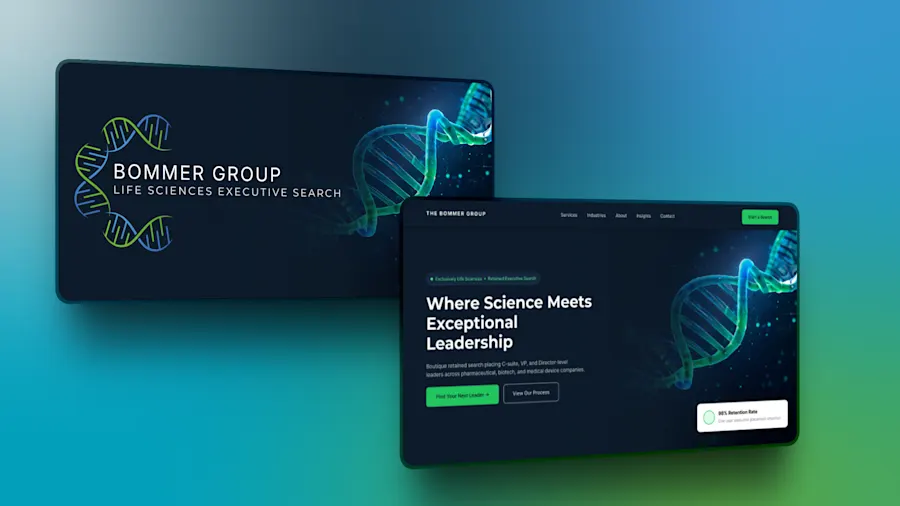
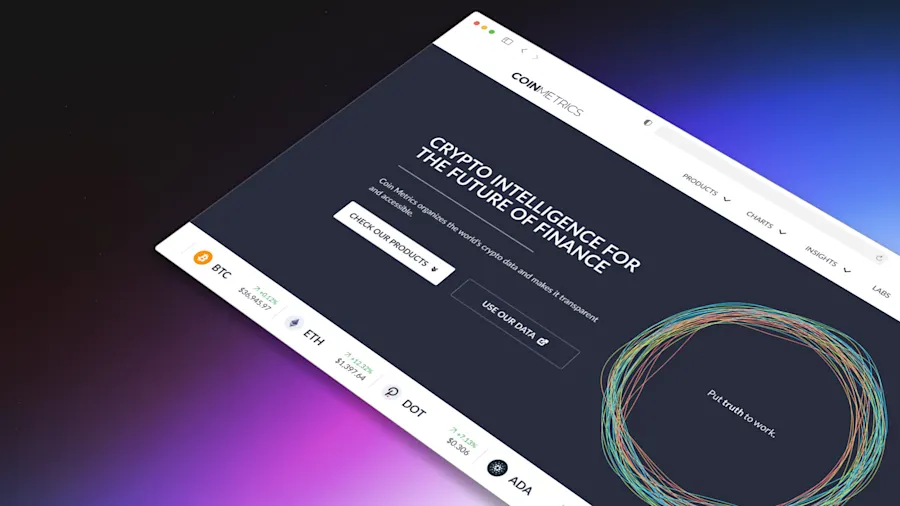
The judgment that shipped work for Salesforce, Coin Metrics, and Fidelity Payment Services is the judgment I bring to focus order and a 4px gap. Seniority shows up in the small decisions, where nobody is watching.
In their words
Two platforms independently vet, rank, and verify the quality of my work. Here's where I stand on both.
Great to work with — eager to help, an excellent communicator, and a quick learner. I would certainly welcome another opportunity to work with her.
Incredibly creative and skilled in her craft, with an eye for both aesthetics and functionality — always one step ahead of marketing asks.
Ashley communicates clearly, sets realistic goals, and always makes sure everyone has what they need to succeed. She's the kind of person who raises the standard for everyone around her.
Ashley was fantastic to work with. Communication was excellent from start to finish, she kept me updated throughout the project, set clear expectations, and turned revisions around incredibly quickly.
FramerCertified Expert
Listedin the official expert directory
I adopted Framer early — before it was the obvious choice — and grew with the platform into a Certified Framer Expert, listed in the official directory. The certification is assessed on shipped work, not a test.
UpworkTop Rated Plus
100%job success score
A perfect Job Success Score across every contract, and Top Rated Plus standing — the badge Upwork reserves for the top 3% of performers on the platform.
15 public reviews · 100% Job Success on Upwork
Accelerants — never the author
The tools changed. The standards didn't. Here's where AI fits — and where it doesn't.
Phases 03 and 04 move faster than they used to. Claude accelerates systems thinking and production code, Midjourney widens visual exploration, and HeyGen handles video — which buys more directions explored in the same week, not fewer hours of thinking.
The rules never change: research before pixels, accessibility always, human review on every output — no vibe-coding, no shipping what a model guessed. I have the skills to do all of it without AI, which is exactly why I can use it safely.
Availability
Some of my best work happened in-house, embedded in full-time teams, and that is what I am looking for now. The last year has been freelance — a lot of it, across a lot of industries — and it kept the craft sharp. If you're hiring a senior UX/UI designer, or a design engineer who can hold both sides, my inbox is open.
Details
A UX/UI designer. That is the profession and it is where the eight years are. Front-end is how I make the design survive contact with production: I know what an interaction costs to build before I propose it, and I can write the component rather than describe it. Designer first, engineer because it made me a better designer.
Yes. I started as a web developer and never put the editor down — React and TypeScript, or Framer and Webflow where those fit better. Component architecture, responsive implementation, and the accessibility work that only exists in markup. This site is one of them; the FAFO Files has the write-up.
As someone who can read the diff. I design with the constraints already in mind, which cuts the negotiation that usually eats a sprint, and I hand over components rather than screenshots. I've led teams of up to seven, so I can hold a design direction across other people's work as well as my own.
As an accelerant, never the author. Claude for thinking and production code, Midjourney for visual exploration, HeyGen for video — woven in where they earn their place. What I don't do is vibe-code and hope. Every AI-assisted output passes the same review as anything I make by hand, and I have the skills to do all of it without the tools, which is exactly why I can use them safely.
Certified Framer Expert, listed in Framer's official expert directory. Top Rated Plus on Upwork with a 100% Job Success Score across every contract — the badge reserved for the top 3% on the platform. I contract through Mercor Intelligence into a top frontier AI lab, which is under NDA. When it comes to in house work, I've worked for businesses from pre-seed startups to Fortune 500 companies, building and maintaining design systems, building applications for web and mobile, and leading teams of up to 7. The full history is on the CV.